Tristan Ulysses Hutgens
30. November 2025 – 27. Februar 2026
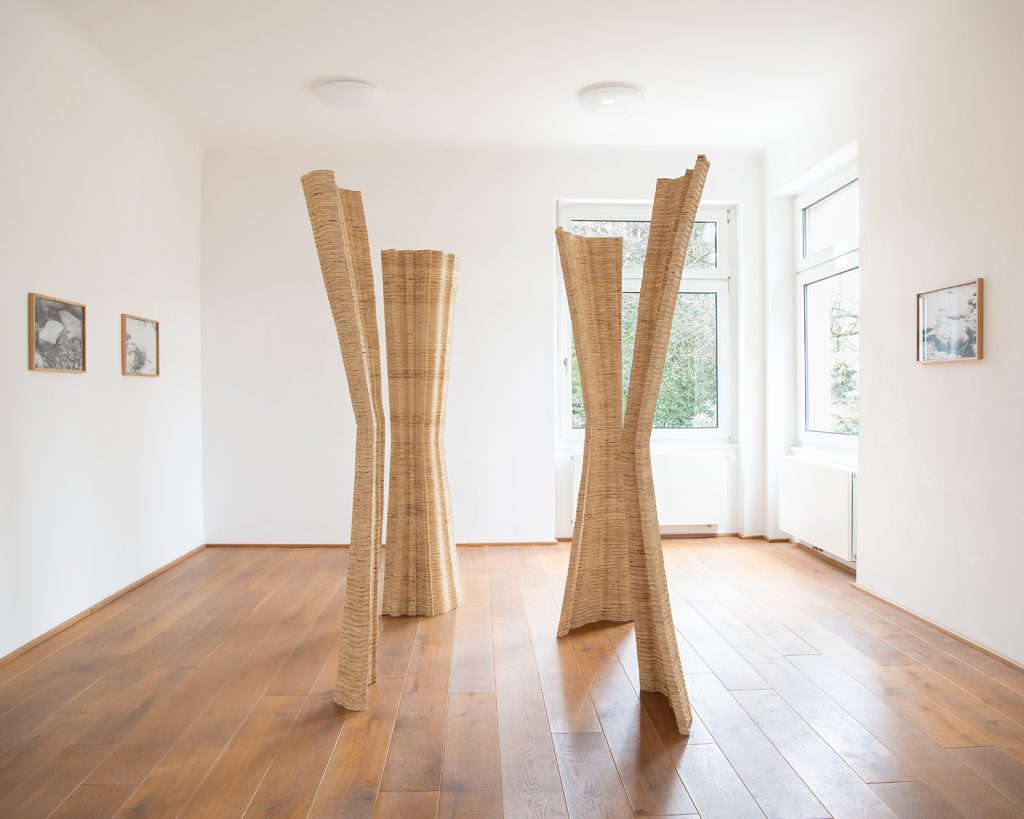
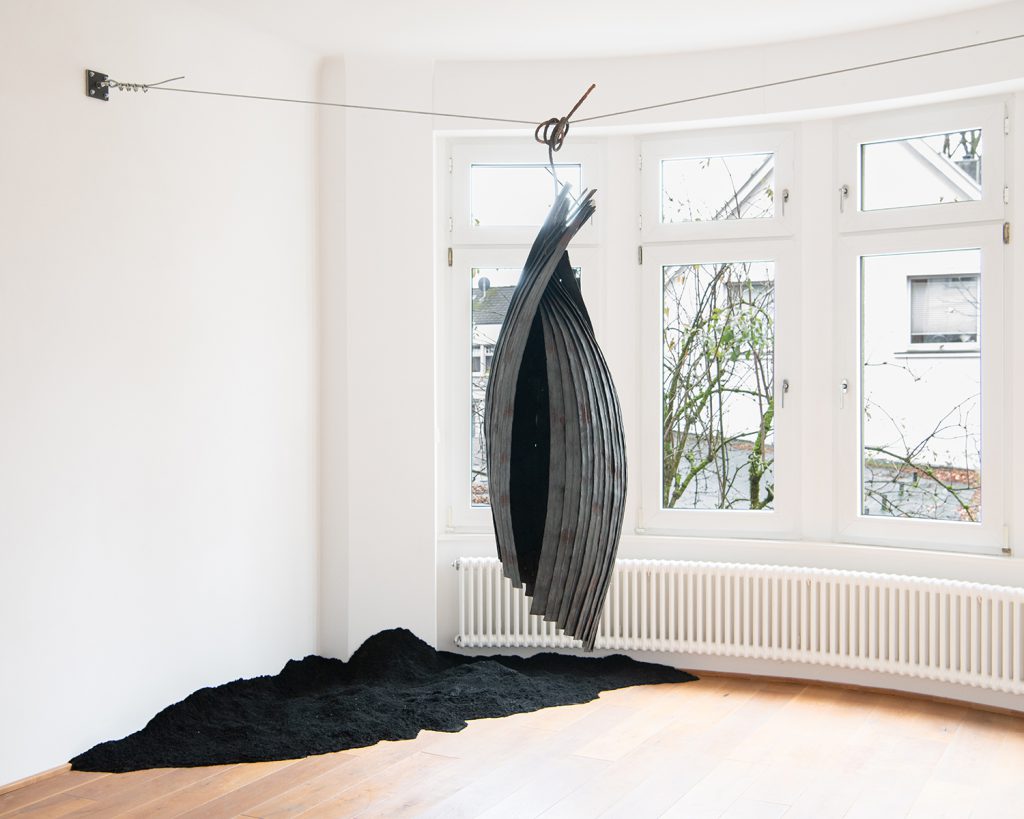
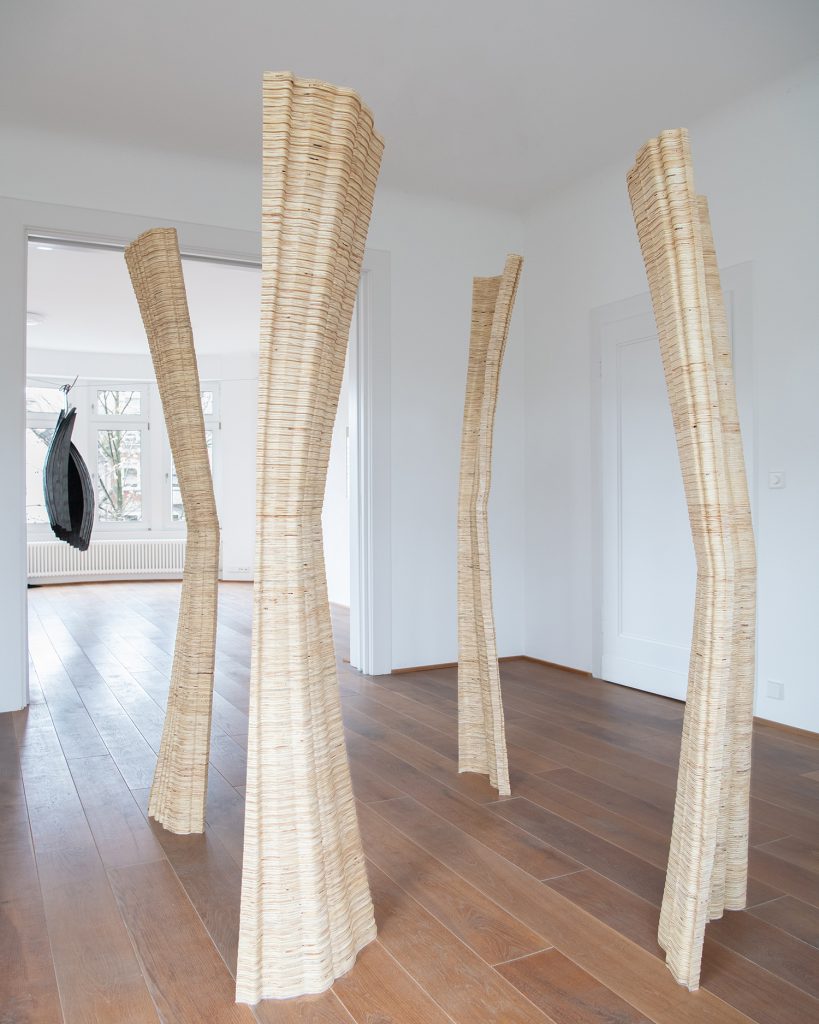
Photos: Tristan Ulysses Hutgens
Although our world seems to be changing ever more rapidly, we nevertheless regard it as a finished ensemble of things or thing-like beings. Paradoxically, more than two and a half thousand years ago, in an environment that was much more static, Greek philosophers viewed the world from a completely different perspective: everything flows or is in motion (Heraclitus). One reason for this shift presumably lies in the fact that we define our lives more and more through our consumption, which surrounds itself with things, uses them up and has developed a very successful commodity production for this purpose. In art, this has led to this commodity mechanism and the living with and handling of it calling for a shift in perspective. The stylizations of individual finished products of our commodity world, either as elementary units of measure – as in Minimal Art – or as glittering icons – as in the Neopop of Jeff Koons – are now worshipped by the art market like golden calves.
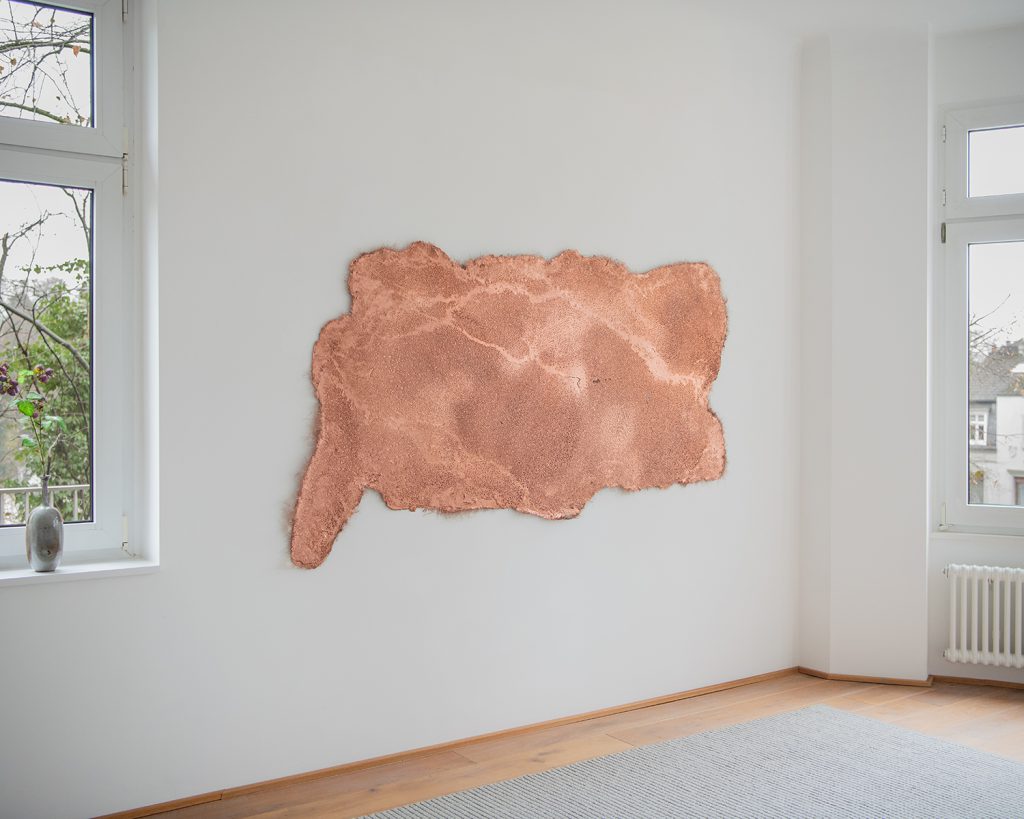
In the question of how art can readjust our attention to what is happening in our world or give rise to deeper reflections, other attitudes are also possible. Instead of directing productive achievements toward the elementary – as in Minimal Art – or toward the totally refined and garish, it can, in the field of sculpture, set out to radically re-question our awareness of materiality. What is concealed behind finished, shiny surfaces? Are such surfaces not something completely illusory? Must we not question these surfaces with regard to their truthfulness, sweep aside the rigidifications and become aware of the forces, energies and processes concealed behind them? And, in the course of this, at the same time lay bare and redirect the underlying attitude of domination of the human being toward his environment in these processes? Must we not call into question the ideal of perfect control over our world that hides behind this? Both viewpoints – uncovering the primal grounds of materiality and calling control into question – drive the sculptural work of Tristan Hutgens. Here nothing is a static, finished thing; rather, everything is redirected toward the processual, nothing is completely pre-planned, but everything is oriented toward self-discovery and self-formation. Hutgens’ studio, as the place where his sculptural formations come into being, resembles a witch’s kitchen in which there is intense bubbling, hot, poisonous-looking vapors shoot upward, mixtures swirl into one another and the cooling or hardening does not seem foreseeable at all. Layer upon layer piles up and seems to continue moving on in ever new displacements. The rules for these processes are not conceived or prescribed from outside but arise from the flow of the material itself and from the amazement at the diversity of the welling forth. Hutgens allows us to take part in the coming-into-being because he arranges the states of his formations in such a way that the becoming is palpable or legible. The resulting form of his sculptural formations never stands at the beginning but always at the end of his sculptural intervention.
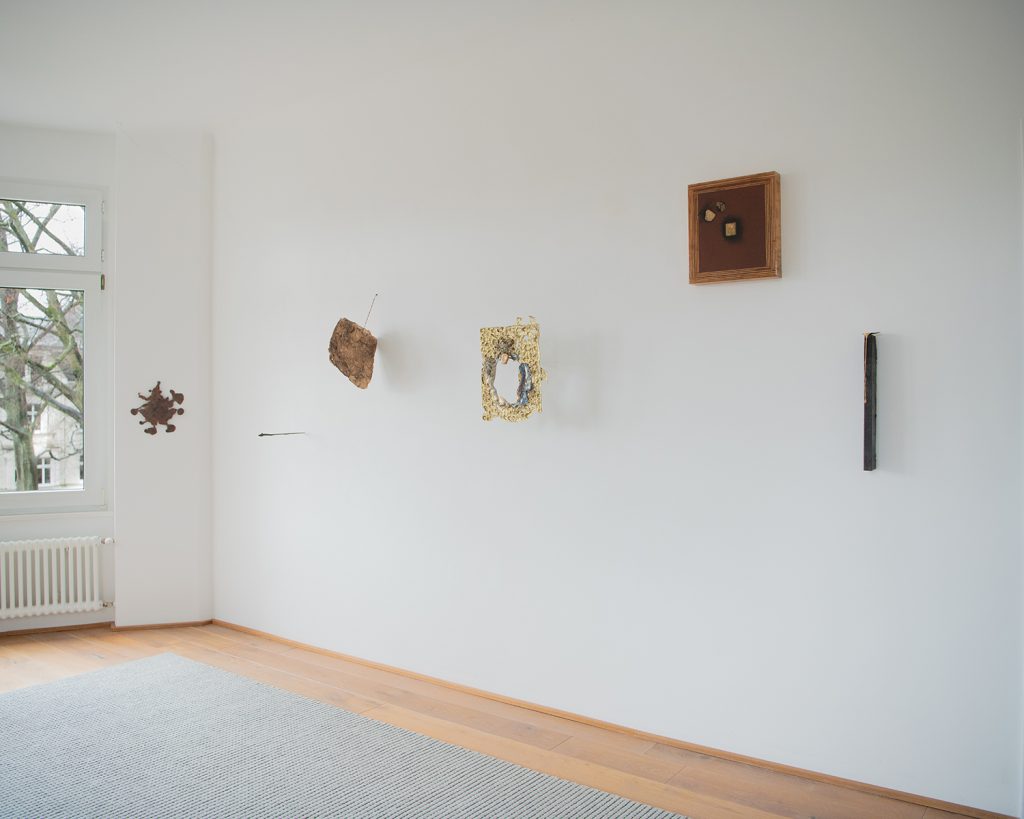
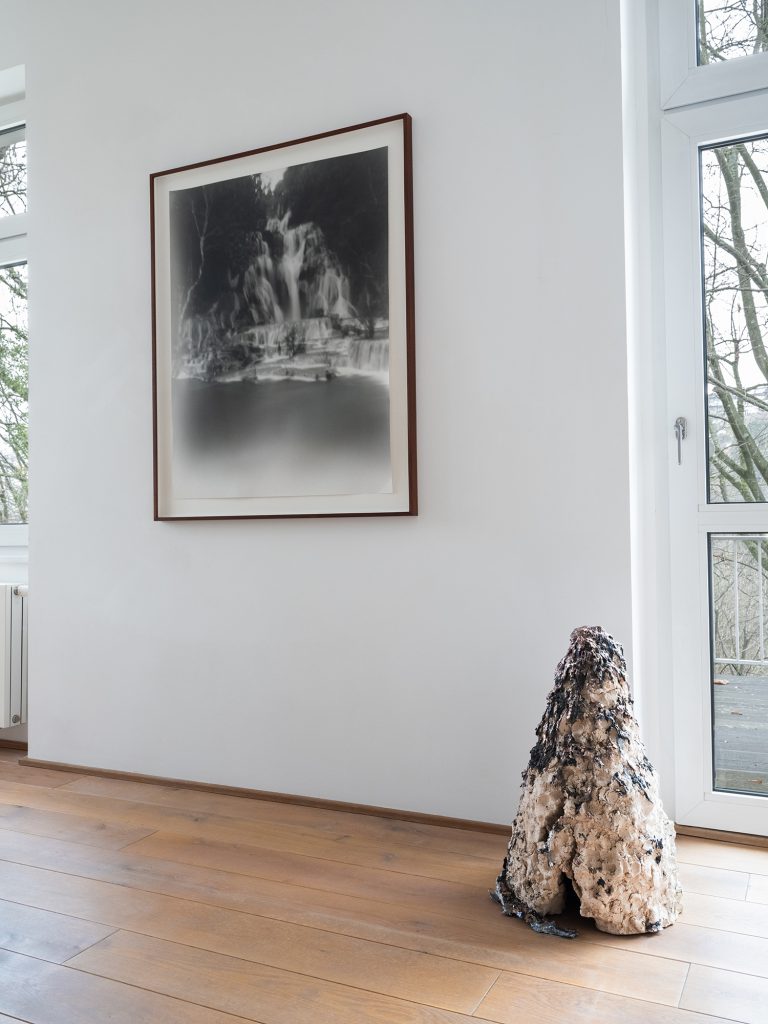
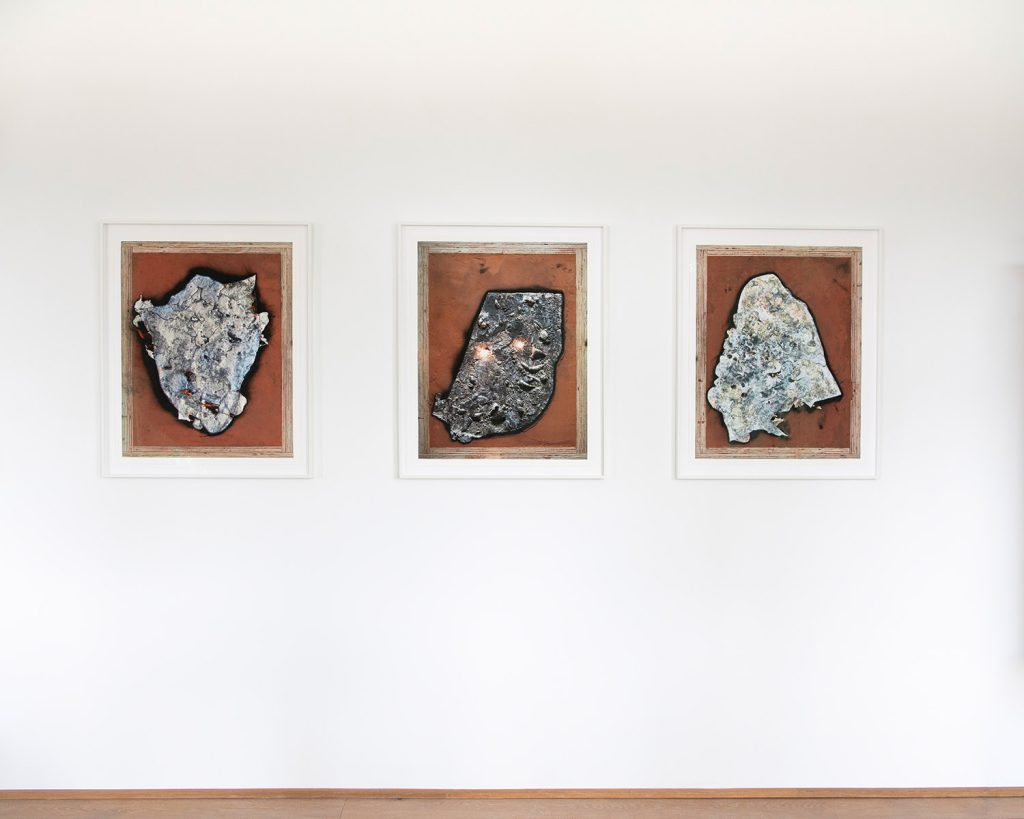
Hutgens engages with the most diverse materials, starting either with the process of emergence – this is particularly striking in the case of metals – or with initial working processes, or with a kind of growth process. In doing so, the material processes are at the same time transformed into the inner essence of the processual character of his sculptural work. His own actions in the form of repeated applications or of inserting or joining things together, or of crossing limits inherent in the material (exceeding firing temperatures), merge with the process sequences of the material. The end of this dialogical process is not foreseeable, is itself a matter of surprise even for Hutgens as its creator, and is the source of the magic that communicates itself to us from his works. At times he leaves the formations that are beginning to emerge at their place of origin, for example in a casting box, and exhibits both together. The spread or growth of his formations is at times derived from everyday external circumstances, such as rain. In a group of works in the exhibition, rain with its puddles provides an initial determination of form. After that, it still influences the surface during the casting (see illustration on the invitation card). In almost all of his works, the use of energy plays an important role, as do the transformations in states of aggregation and in the corporeality of the material. In his studio he generates temperatures of up to 3100 degrees, at which it is difficult to judge whether material generation or material destruction is setting in. Expressed in a metaphor from nature, he can bring the material to blossom or expose it to decay and explore the narrow boundary that separates the two. “Scale” (“Zunder”), for example, is nowadays known only through linguistic images – as a waste or flaking product of glowing metal, almost never experienced bodily by any of us. As a floor installation it is a faintly smelling, dark, dull mass whose consistency as a formation is difficult to assess.
However, for Hutgens it is not simply a matter of taking up the primordial phenomenon of the emergence of material, but at the same time of making its effect on our own bodily experiences clear. For the human body becomes “Leib” when it, in feeling, opens itself to its surroundings. The tactile feedback is significant in all of Hutgens’ formations. In the same way, this also applies to the visual domain. Therefore, Hutgens repeatedly uses photography as a visual anchor in the drifting and onward movement of material behavior. However, he strips photography of its supposedly distanced neutrality and uses its own sensitive processuality, with differing emulsion and development behavior, to participate in his works. Hutgens’ curious and exploratory attitude thereby revives techniques that seem long since past, such as gum printing. He is also interested in the medial transfer that accompanies the production of images in contrast to the production of formations. Moreover, the medium serves him to free himself from being swept along by the material changes and to observe in himself what he has let himself be drawn into by the logic of the material. In his formations, Hutgens also devotes himself to the theme of joints, the delicate connections of materials with one another or their transitions into one another. How can it be grasped, how can it enter into linkages, in what surroundings can it find a place, how can it stand or hang and thereby redefine surroundings?
His sculptures are not easy to appropriate. The gaze is swept along by the flow of the material. It seems as though there is no beginning and no end. Unlike in formal sculpture, it is not possible for the eye to take in the formations in a single glance or to discover a point of anchorage from which everything is derived. In this open, perceptive exploration, something of the processual character to which his formations are subject is itself realized, and this lends them a liveliness that calls to mind not so much objects as beings. The material, in its shifting surfaces, its stratifications and its unforeseeable developments of form, demands an unstrained way of seeing. In the course of this, it becomes apparent through what elaborate processes the respective sculptures have peeled themselves out, something that, in comparison with the practices of the commodity world, is without equal in this world geared toward efficiency. Since Hutgens works out his formations exclusively in his own studio, and since his investigations of material and material resurrections take place only there, his own body is present in these formations as if invisibly, and in doing so also defines for them a measure that has been lost in today’s production of things in the commodity world. This measure, in connection with simultaneously allowing the self-generation of the material to come to speech, gives his formations an implicit inner human liveliness and a sense of an exploration of this liveliness, of its openness and of its possibilities, which here are not unlimited but embedded in their surroundings.
Why is it all the more important today to engage with materiality? We no longer understand what the world looks like behind the façades of the surface. They leave us in the dark about the hidden materialities. Moreover, in the media world, with the primacy of virtuality, a sense for what is authentic in material has been lost. Is it not necessary to undermine today’s world, which always appears as already finished? Must we not at the same time reassure ourselves against the virtual by means of the real? And must we not once again open ourselves up, or make ourselves curious, to what is developing, what is unforeseeable, which – contrary to our stylizing ourselves as gods – has been placed in our hands?
Rolf Hengesbach